Check out our friends over at Special Operations Wounded Warriors. The SOWW team is passionate about helping our wounded SOF vets and they create one of a kind experiences to show support and say thanks for the serious sacrifices of our SOF vets and their families.
Past events have been labeled "takin bacon" (hint: SOF guys, gear and guns in the backwoods of SC) and were examples of the very best of the type of support shown to our SOF vets. Combined with gear giveaways from some of the industries top brands, and good food, these events have been huge successes. Next years event should be even bigger.
If you know, or know of a wounded SOF vet that may be interested, contact the SOWW team or ADVENTURE OPERATIONS GROUP for more information.
Head over to their site and show them support or better yet, plan to attend a future SOWW event, you won't forget it.
B-Rad
Showing posts with label Tactical Adventure Training. Show all posts
Showing posts with label Tactical Adventure Training. Show all posts
Monday, July 8, 2013


Thursday, May 2, 2013
Bug Out Basics- Part 2
Part two in a series on Bug Out/Bail Out tactics from AOG teammate Josh:
If the exact same situation happened in Iraq or Afghanistan,
you can bet the long gun is coming with.
Talking to some coworkers last night we went over every situation we
knew of where people had to un-ass a vehicle and most said that at the time
they were worried about just getting out and grabbing ANYTHING was second on
the priority list. Several made mention
of grabbing their bags but burning everything else (including belt feds) in
place. I’m not saying if any of these
actions are right or wrong only that the situation dictates what we’re going to
do.
Another situation might be some kind of natural
disaster. For this situation let’s
assume we’re ahead of the power curve and a disaster is pending, but hasn’t
occurred yet. Some examples might be
hurricanes, tornadoes, fires, etc. Often
times the routes from a city to a more rural area become clogged. We might just need to make it from our home
or business to another “better” location.
In this situation we will probably encounter many more people, both good
and bad.
Again, is the long gun necessary? Maybe not yet, but I probably wouldn’t want to leave all my guns to be burned in a fire. I’d like to think that even if I don’t need the rifle right now, it might be the only chance I have to keep possession of one.
The next logical “threat” would be the same situations
above, but, for whatever reason, we’re in the thick of it or post
disaster. Think hurricane Katrina or
some of the looting I’ve seen in the Midwest post tornado. In this situation we can expect more social
unrest, historically meaning people become more desperate and predatory. Do we need a long gun?? If I’m moving through an area full of people
capable of horrible acts for their own self preservation I’m probably even more
inclined to move as quickly as possible.
I don’t think provoking any actions from people in this type of
situation is advisable. What I mean by
provoking is giving them any reason (in their eyes) to interact with you. Moving as quickly and quietly as possible
seems to, again, be the best answer.
I’m going to stop there because any situations we come up
with past this are probably not based on history and might seem a bit “far off”
for some. I think the examples we’ve
chosen are somewhat realistic and if we discuss these events we probably can
get some decent ideas for “end of the world, social breakdown, zombies, et
al."
So what are our choices??
Leave the long gun, hide the long gun, take the long gun but have it
concealed, take the long gun and look like you’re ready for a fight? Anything else?
Long gun and movement considerations
There seems to be quite a bit of discussion about “bugging
out” and what kit to carry. There are
plenty of options out there but one question that continues to come up is how
to stay “the grey man” and still carry a long gun. I think we need to take a hard look at our
situation, the circumstances we might find ourselves in, and what to do about
that long gun. Because we need to have
some context to our situation we’ll try to paint in broad strokes, and add
specifics as necessary. To be honest, if
we keep things realistic I think we’ll find most decisions won’t be too
different no matter the circumstances.
By definition “bugging out” means we are moving. We want to move from point A to point B. What are our points??? Our home??
Work? A vehicle? A public forum? A predetermined “safe” house or sight?? A hasty hide or building to occupy?? By definition we are trying to get somewhere
of lesser advantage to a place of better advantage. The exception would be moving to SOMEONE,
like our family or friends in need, someone in trouble or disabled, etc.
Regardless of why we are leaving we have determined that we
need to be somewhere else. Inherently
that means we have a purpose and to move accordingly. I can’t think of a single reason to move and
not have a destination and not be highly motivated to get there. Even if you don’t have a specific location
and only know the place you’re at is sucking, you still probably aren’t going
to move like it’s a Sunday drive. Speed
becomes a factor.
For this discussion we’re going to talk about moving on
foot. If we have a vehicle then the point
is almost moot. Believe me, if I’m
"alamo’ing" up or moving in a vehicle then the gear I chose and the time and
distance I can cover are a different discussion.
So if we’re moving on foot we need to be VERY conscious of
what we carry. There are tons of
discussions about what and how people will carry life saving equipment and
comfort items. We can talk about that
too, but the one item that continues to arise is that pesky long gun. Do we need it?? Should we take it?? How?
What if we don’t take it?? What
are we going to do with it??
Answering some of these questions and coming up with some
solutions might help us in the rest of our load out. Determining what we carry and how we carry it
also determines what we can accomplish.
Things like where we can go and how far we can travel are directly
related to the solutions above.
Simple math tells us we can go farther without a long
gun. If I forgo a long gun (in this
case an M4 carbine) that means I don’t have a 7-10 pound rifle and 3-10 pounds
of ammo (one mag weighs approximately 1 pound).
Can you move farther with 10-20 pounds less?? I think I can.
What do we consider in making that determination? Now things get somewhat tricky. Each person envisions different
situations. I think the biggest
consideration is the geographic location we find ourselves in as well as the
circumstances that have made us move.
Let’s run down a few somewhat generic situations and make some decisions
from there.
PART 2
Back to the topic.
When do we need a long gun?? Do
we need one if our vehicle broke down on a rural road and we’re trying to walk
to help? Probably not, but are we
comfortable leaving it in the vehicle?
That also depends. It depends on
if you have it in something like a Truck Safe, and what the overall situation
is like. If we know it’s only about 10
miles back to somewhere we can get some help then it might be better to leave
the rifle and haul ass to a known destination.
It’s about probabilities and in this situation, stateside, it’s probably
best to leave the long gun. Even with a
longer distance (for you truly rural folks) I don't think it changes much.
Again, is the long gun necessary? Maybe not yet, but I probably wouldn’t want to leave all my guns to be burned in a fire. I’d like to think that even if I don’t need the rifle right now, it might be the only chance I have to keep possession of one.
More on those choices in Part 3, coming next week.
Until then, stay full tilt and focused!
Sunday, April 28, 2013
Bug Out Basics
From AOG Teammate Josh-
The concept of “bugging out” is not new, although there are
some new twists. The premise is whatever
situation we are in, we need to be somewhere else that is better. The reasons are many; natural disaster,
disabled vehicle, terrorist attack, etc.
One constant is having a small bag that will assist you in getting from
point A to point B. The bag, sometimes
called a “go bag” or “bugout bag”, should be easily accessed, easy to
transport, and contain whatever items needed to augment your personal gear and
be appropriate for whatever location you’re in.
A few things to consider when choosing a bag for this
purpose are its overall size, how it’s going to be carried, and the general
appearance of the bag. I’ll expand on
each point. If a bag is too big it will
inevitably get overloaded with things you probably want but don’t necessarily need. This becomes contrary to being easy to access
and easy to transport. If it’s too small then obviously it might
not be able to carry essential items.
Backpacks make a perfectly good platform for a go bag but it becomes
very difficult to access items in the bag quickly. A shoulder bag, fanny pack, or lumbar pack makes
access much easier. The tradeoff is more weight can be carried
easier in a backpack. The overall
appearance of the bag should be complimentary to you as well as the environment
you are in. A soldier working in Baghdad
will probably need a bag that appears different than a bag for a soccer mom in
St. Louis. The point is it might be best if the bag doesn’t draw undue attention
while moving within your environment.
I’m not going to delve into the exact contents of the bag
but where you are will generally determine what you need. If you are in the desert the procurement and
carriage of water might be high on the list.
If you find yourself in a non permissive environment maybe a few extra
mags, night vision, and a satellite phone might be needed. I would concentrate on communications,
signaling, self defense, and basic needs like staying warm and hydrated. Most importantly we are trying to get from
point A to point B. I would suggest
items that help accomplish that specific goal.
Tuesday, August 14, 2012
2-day Cathedral Traverse, Grand Teton National Park- Part 1 "Don't Stop, Don't Fall"
"At least once a year, do something bold, that requires real effort, real risks and where the outcome is uncertain"- B-Rad
Mission: Try to hang with Brenton Reagan of Exum Mountain Guides for 2 days in the Grand Tetons.
He had thrown down the challenge to me 2 years ago at the Outdoor Retail Show in Salt Lake City. "Come out to Jackson Hole, let me show you what we do for a few days". He had repeated the challenge this year. I knew that Exum was one of the most respected Guide services in North America. I knew that the Tetons contained difficult routes. This was exactly the kind of thing I love dropping into. I had to go. So this year, I took him up on the offer. We would attempt a 2-day, alpine style assault on the Grand Traverse, a route that contained some of North Americas most challenging and technical alpine terrain.
I had carved out some time in early August for the trip. It would be difficult for sure as I had a compressed schedule, with 1 day to acclimatize and 2 days to complete the route. There would be no warm up or practice climbs, we would jump straight into it.
I arrived in Jackson Hole on Saturday August 4, 2012 in the late afternoon. The drive from Jackson Hole Airport to Teton Village, revealed a bustling heavy summer crowd that ranged from climbers, hikers, mountain bikers and kayakers, to large groups of Harley riders, cowboys, families in RVs and everyone in between. Jackson Hole,WY is a mecca for just about any type of outdoor recreation you can think of.
 I checked into my room at Teton Village late Saturday afternoon. Teton Village is approximately 11 miles from Jackson Hole, and sits at about 6600 feet altitude. In the winter, Teton Village is the spot for some of the best skiing the West has to offer. In the summer, Teton Village is transformed into a world class downhill mountain biking resort but also boasts miles of accessible hiking trails, nearby whitewater rafting, horseback riding, wildlife tours, paragliding, and sits on the border of Grand Teton National Park.
Grand Teton National Park is home to some of the most beautiful mountains found anywhere in the world, and some of the best alpine mountaineering in North America. Exum Mountain Guides is among the oldest and most respected Mountain Guide Services in North America. Exum's AMGA certified guides are in a league of their own when it comes to leading clients on truly inspiring and challenging adventures. Exum has been guiding clients on the "Grand" longer and with more summit success than any other company.
Check them out here- http://www.exumguides.com/
With only a day to adjust to the altitude since arriving from VA at sea level, I decided to spend Sunday drinking water and going for a short hike on a nearby trail just to get loosened up.

I met up with Brenton at 1:45 AM Monday morning, for the drive into the park. After a quick stop at Exum's office, we arrived at the Lupine Meadows parking lot at about 2:30 am, and began the job of finalizing our gear. We divided up the tent and climbing gear, cinched down our packs, turned on our headlamps, and were on the move by 3:00 AM.
The summit of Teewinot was our first goal, but to get there required gaining approximately a mile's worth of altitude. We hiked through the darkness initially on a small well marked trail, later encountering steep switchbacks that slowly gave way to rock fields and class IV scrambling. I was already feeling the effects of the altitude, but kept pushing and reciting my mantra for this trip, "Don't stop, don't fall". We set a robust pace and I was glad that I had chosen the type of training I had been practicing for the past few months. Even so, I had to ask him to slow down just a bit a few times. Exum's guides can move fast and light in the mountains. Eventually, as we neared the summit and the first signs of daybreak began to appear, we dropped our packs and Brenton tied me in to a short rope, and we set out for the summit. We tagged the summit of Teewinot at about 6:30 AM, and from there the view in all directions was spectacular. 1 down, how many to go?

Dark clouds approached from the Southeast (seen behind me in the above picture), and revealed evidence of what local forecasters had predicted as a 40% chance of showers for Monday August 6, 2012. Soon, we were taking cover next to a rock wall, wearing all of our Gore-Tex as we waited out a 30 minute rain storm. We contemplated turning back, but saw no lightning and soon the rain ended. We decided to push on.
The rain made the climbing slow, and a little treacherous for the next few hours as the overcast skies slowed the drying out of the extremely exposed and challenging terrain between the summit of Teewinot and Mount Owen. "Don't stop, don't fall". We continued our slow push to Owen. Down climbing, rappels, exposed ridges, ice ax and snow to the Koven col. A fall here, would not be good. "The Summit of Mount Owen is one of the most difficult summits in the park, by it's easiest route", Brenton said as we tagged it and started our down climb. I was feeling the effects of little sleep and a rush to 12,928 feet, "Don't stop, don't fall".
The rain and resulting slow climbing meant that a 2 day Grand Traverse probably wasn't going to happen, combined with my short time at altitude, our progress wasn't fast enough to go for the traverse. I was physically and mentally crushed after 13 hours of hard climbing on day 1, still moving and climbing, but probably not fast enough to make it over the Grand before dark. We decided to bivy on the West Ledges, between Mount Owen and the North Ridge of the Grand. It was a good call, I needed to recharge. This mission was now a 2-day Cathedral Traverse, and we still had one full day of very challenging climbing ahead of us on the Grand.


At the bivy site on the West ledges, unreal view. We arrived with about 8 OZ of water each, and no snow melt to refill. Brenton rapped into the Gunsight notch, chopped snow with an ice ax, and climbed back out so we would have snow to melt for water. Much appreciated!
A night's sleep at near 12,000 feet was exactly what I needed. I woke up feeling stronger. Day 2 would be heading toward the summit of the Grand, via the North Ridge and Italian Cracks. Some GU, a little cheese and salami, and snow melt water for breakfast and we were moving again.

The first of 11 pitches on the way to the summit.


Mission: Try to hang with Brenton Reagan of Exum Mountain Guides for 2 days in the Grand Tetons.
He had thrown down the challenge to me 2 years ago at the Outdoor Retail Show in Salt Lake City. "Come out to Jackson Hole, let me show you what we do for a few days". He had repeated the challenge this year. I knew that Exum was one of the most respected Guide services in North America. I knew that the Tetons contained difficult routes. This was exactly the kind of thing I love dropping into. I had to go. So this year, I took him up on the offer. We would attempt a 2-day, alpine style assault on the Grand Traverse, a route that contained some of North Americas most challenging and technical alpine terrain.
I had carved out some time in early August for the trip. It would be difficult for sure as I had a compressed schedule, with 1 day to acclimatize and 2 days to complete the route. There would be no warm up or practice climbs, we would jump straight into it.
I arrived in Jackson Hole on Saturday August 4, 2012 in the late afternoon. The drive from Jackson Hole Airport to Teton Village, revealed a bustling heavy summer crowd that ranged from climbers, hikers, mountain bikers and kayakers, to large groups of Harley riders, cowboys, families in RVs and everyone in between. Jackson Hole,WY is a mecca for just about any type of outdoor recreation you can think of.

Grand Teton National Park is home to some of the most beautiful mountains found anywhere in the world, and some of the best alpine mountaineering in North America. Exum Mountain Guides is among the oldest and most respected Mountain Guide Services in North America. Exum's AMGA certified guides are in a league of their own when it comes to leading clients on truly inspiring and challenging adventures. Exum has been guiding clients on the "Grand" longer and with more summit success than any other company.
Check them out here- http://www.exumguides.com/
With only a day to adjust to the altitude since arriving from VA at sea level, I decided to spend Sunday drinking water and going for a short hike on a nearby trail just to get loosened up.

I met up with Brenton at 1:45 AM Monday morning, for the drive into the park. After a quick stop at Exum's office, we arrived at the Lupine Meadows parking lot at about 2:30 am, and began the job of finalizing our gear. We divided up the tent and climbing gear, cinched down our packs, turned on our headlamps, and were on the move by 3:00 AM.
The summit of Teewinot was our first goal, but to get there required gaining approximately a mile's worth of altitude. We hiked through the darkness initially on a small well marked trail, later encountering steep switchbacks that slowly gave way to rock fields and class IV scrambling. I was already feeling the effects of the altitude, but kept pushing and reciting my mantra for this trip, "Don't stop, don't fall". We set a robust pace and I was glad that I had chosen the type of training I had been practicing for the past few months. Even so, I had to ask him to slow down just a bit a few times. Exum's guides can move fast and light in the mountains. Eventually, as we neared the summit and the first signs of daybreak began to appear, we dropped our packs and Brenton tied me in to a short rope, and we set out for the summit. We tagged the summit of Teewinot at about 6:30 AM, and from there the view in all directions was spectacular. 1 down, how many to go?

Dark clouds approached from the Southeast (seen behind me in the above picture), and revealed evidence of what local forecasters had predicted as a 40% chance of showers for Monday August 6, 2012. Soon, we were taking cover next to a rock wall, wearing all of our Gore-Tex as we waited out a 30 minute rain storm. We contemplated turning back, but saw no lightning and soon the rain ended. We decided to push on.
The rain made the climbing slow, and a little treacherous for the next few hours as the overcast skies slowed the drying out of the extremely exposed and challenging terrain between the summit of Teewinot and Mount Owen. "Don't stop, don't fall". We continued our slow push to Owen. Down climbing, rappels, exposed ridges, ice ax and snow to the Koven col. A fall here, would not be good. "The Summit of Mount Owen is one of the most difficult summits in the park, by it's easiest route", Brenton said as we tagged it and started our down climb. I was feeling the effects of little sleep and a rush to 12,928 feet, "Don't stop, don't fall".
The rain and resulting slow climbing meant that a 2 day Grand Traverse probably wasn't going to happen, combined with my short time at altitude, our progress wasn't fast enough to go for the traverse. I was physically and mentally crushed after 13 hours of hard climbing on day 1, still moving and climbing, but probably not fast enough to make it over the Grand before dark. We decided to bivy on the West Ledges, between Mount Owen and the North Ridge of the Grand. It was a good call, I needed to recharge. This mission was now a 2-day Cathedral Traverse, and we still had one full day of very challenging climbing ahead of us on the Grand.


At the bivy site on the West ledges, unreal view. We arrived with about 8 OZ of water each, and no snow melt to refill. Brenton rapped into the Gunsight notch, chopped snow with an ice ax, and climbed back out so we would have snow to melt for water. Much appreciated!
A night's sleep at near 12,000 feet was exactly what I needed. I woke up feeling stronger. Day 2 would be heading toward the summit of the Grand, via the North Ridge and Italian Cracks. Some GU, a little cheese and salami, and snow melt water for breakfast and we were moving again.
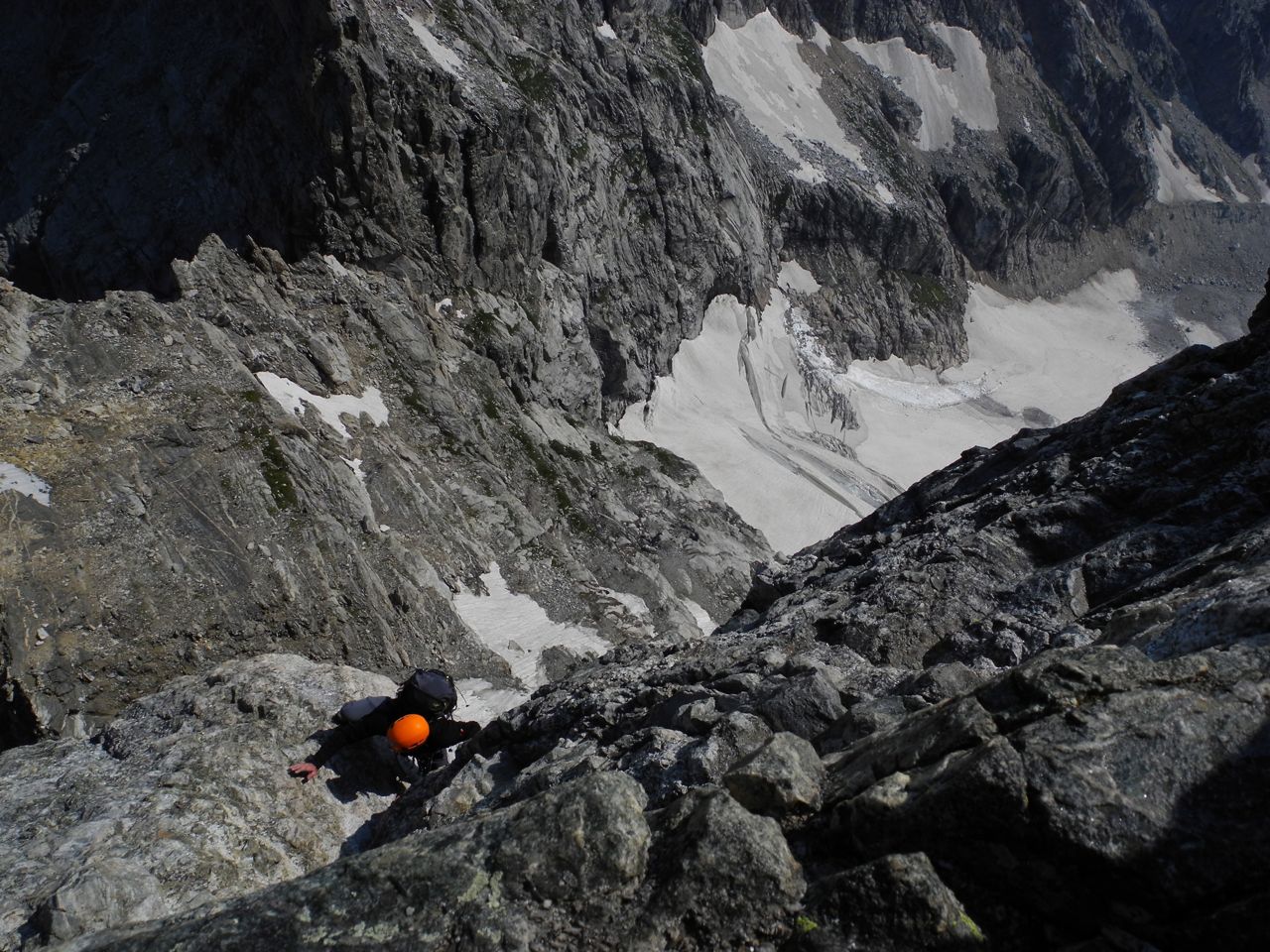
The first of 11 pitches on the way to the summit.

AOG Individual Capabilities Enhancement (I.C.E) training with Exum!

"Don't stop, don't fall" Climbing through this section required total focus and control. Little margin for error and no place to fall. 2-man team, over 13,000 ft high on an alpine mountaineering route means relying on your training, physical condition, equipment and each other.


Summit shot on the Grand, 2 day Cathedral Traverse.
Climbing with Exum is unlike any other experience, because they are unlike any other guide service. They will put you in the middle of real adventure, and you will come away with new or renewed skills, and a sense of achievement that will leave you wanting more. Brenton, one of Exum's most experienced guides, is also involved with XMS3, Exum's Military and Special Operations Mountaineering Programs. You will not find a more advanced or relevant training program anywhere that will prepare your unit or team for the dynamic challenges of conducting tactical operations in an alpine setting. Check out XMS3: XMS 3- Mountain Systems Safety Survival
This was a tough 2 days. I arrived in Jackson Hole with one day to get ready, and found myself being truly tested from the very beginning. Capabilities stretched, skills enhanced and new friends made!
This trip is accessible and achievable by anyone willing to put in the preparation and training. The summit of the Grand is within your reach. Exum specializes in 1 or 2 day summit climbs. Contact AOG to find out how I planned for this trip, or contact Exum if you are ready for the challenge!
Wednesday, July 20, 2011
Get yourself "in the zone", read "Click. The magic of instant connections"
 This is a book about those mysterious moments when we click in life. Those moments when we are fully engaged and feel a certain natural chemistry or connection with a person, place or activity. Written by brothers Ori and Rom Brafman. Ori is an organizational business consultant and Rom is a psychologist. Click is a psychological investigation of the forces behind what makes us click. What are the hidden forces working to make these magical connections occur? Click accelerators: vulnerability, proximity, resonance and similarity are explored and the authors explain how they work together to create "peak experiences". If you have ever been "in the zone" even once, at work, at play or in a relationshiop, and want to know if it's possible to increase your chances of finding your way back to the zone, check out this book. If you regularly live "in the zone", Click will help you to understand what's going on behind the scenes when it all just feels right and you are in tune and connected to the immediate world around you.
Exerpts from Click
..."similarity, no matter what form it takes, leads to greater likability."
"Nonetheless, the relationship between industrialization and depression is so strong that scientists know there is some correlation between the two. What is it about the process of a country becoming industrialized that leads to depression?"
"The experience of men facing life-or-death situations together created unbreakable bonds. In other words, it didn't matter what type of person went into combat-simply the fact that they faced combat together made the soldiers' bond stronger. It is one of the most emotionally charged experiences imaginable."
A quick and easy read, check it out.
Sunday, May 8, 2011
AOG Northern Virginia T.A.C May-2011
Finished up a 2-day Tactical Adventure Course last week. This was a great group of very smart guys who do important work that you've probably benefited from and didn't even know it. (read that as engineers who build some cool stuff)
 Getting started in the classroom with an introduction to some AOG principles, a discussion about elite teams and an overview of what was to come over the next 2 days.
SURVEILLANCE Exercise! They drank from the firehose on Day 1 as we covered alot of info in a short time. Before they knew it classroom time was over and it was into the heart of Richmond to try out some urban tracking. The knowledge and skills they learned throughout the day, and the chance to put it to practical use, will keep them safer in their personal and business travels. Most of them also acquired a new appreciation for some of the very difficult behind the scenes work that allows groups like the SEALs and other SOF units to have the information they need to pull off daring missions.

The morning of Day 2 brought with it a steady rain, perfect conditions to learn the finer points of tactical off-road driving from the best. Here the guys are getting introduced to the concept of "mission critical" vs "hey yall watch this" forms of off-road driving.

Once again, we covered alot of info in a short time. You never imagined there was so much to learn about "tactical mobility".
 Class is over, time to go. Has anyone seen my Arc Teryx?
 These guys liked to know what they were about to get into.
 High and dry on some easy stuff.
 Won't stay high and dry for long. Vehicle recovery is a mission critical skill and an extension of your driving.
 Extreme AOG teambuilding, suck factor on the rise. Time for action.
 Any great team requires high levels of innovation. As the day wore on, we required lots of it.
 The action continued all day, and ended with a surprise event that some found to be eye opening!
These guys were great, and though they were sometimes too critical on themselves and rated their own performance too low, they thought thru tactical problems, came up with innovative ideas and worked together to get thru some big challenges.
Mission accomplished, well done guys.
Special thanks to the AOG team and the awesome instructors at ORT!


The morning of Day 2 brought with it a steady rain, perfect conditions to learn the finer points of tactical off-road driving from the best. Here the guys are getting introduced to the concept of "mission critical" vs "hey yall watch this" forms of off-road driving.

Once again, we covered alot of info in a short time. You never imagined there was so much to learn about "tactical mobility".


These guys were great, and though they were sometimes too critical on themselves and rated their own performance too low, they thought thru tactical problems, came up with innovative ideas and worked together to get thru some big challenges.
Mission accomplished, well done guys.
Special thanks to the AOG team and the awesome instructors at ORT!
Subscribe to:
Posts (Atom)