WELCOME TO ADVENTURE OPERATIONS GROUP


Adventure Operations Group (AOG) is a veteran owned company dedicated to the pursuit of adventurer. AOG's Training Programs and Adventures will take you "Beyond Normal Limits". AOG leads epic adventures, instructional programs, leadership training and assessments for individuals and organizations. Our programs are unique and emphasize mental focus, individual skills, leadership and personal achievement. We specialize in Human Performance Training. Working with AOG is the best way to achieve "next level" results for your corporate group or to enhance your personal capabilities. Contact AOG today to learn how we can get you or your team "Beyond Normal Limits".

http://www.adventureoperationsgroup.com/


Showing posts with label Teambuilding. Show all posts

Sunday, February 22, 2015

Corporate Survival- Part 3 no win situations


Corporate Survival- It's your choice.


Are you stressed out at work or frustrated in your career?  If you said yes, you are not alone.  Today, more employees than ever before are experiencing unhealthy levels of stress and frustration in their jobs.

Conditions such as under performing peers, unsuccessful managers, organizational instability, and marketplace disruptions plague almost every team, project and company.  These conditions can make life almost unbearable at times for individuals that are forced to endure them, creating unhealthy levels of stress that can impact every facet of our lives. 
 
Don't think for a second that organizations always get it right when making strategic decisions, managing the day to day or promoting or hiring for key positions, they often don't.  Your individual situation at your company, regardless of the size of your organization is a multi-faceted and complex operating environment that is influenced by decisions and inputs from many stakeholders, often with competing and disparate agendas.  The larger your organization, the more complex and competitive your industry, increases the likelihood that the level of dysfunction and misalignment in your day to day is at unhealthy levels.  Understandably, almost no organizational decision is made with the individual in mind.  Many times the real reasons behind decisions that have a direct impact on you, seem confusing or even contrary to the success of the business. 

Also, don't forget that running companies, managing teams and projects is very difficult work.  Decisions by managers are often made with incomplete information, compressed schedules or other confidential factors and are forced upon teams that are understaffed or caught up in the midst of change.  Sometimes, depending on the industry, decisions made by senior managers can take months or years before the determination can be made as to whether or not the decision was correct, or successful.  Often times, the person who made the original decision is no longer there, and there is a new manager, maybe it's you, who is attempting to execute strategy that may not even be correct.  Sound familiar? 

Some people have endured circumstances described above for so long that they think it is normal, or the way it's supposed to be. 

There are many business books and support mechanisms in place to increase your leadership skills, improve your communication, motivate you towards making the entrepreneurial leap and so on.  But the truth is that most individuals are compelled to endure their current situation for longer than desired, longer than is healthy, longer than they should, out of necessity or more specifically, out of survival. 

Has this ever happened to you or someone you know?  What should you do if you find yourself in an unpleasant situation at work that is causing too much stress and anxiety and for whatever reason you cannot break away from it? 

Take immediate steps to increase your situational awareness.


Engage your organizational OODA (Observe, Orient, Decide, Act) loop.


  1. Observation is your most critical skill. You may not be able to escape the situation, but you will be better able to survive it by learning as much as you can.  Consider factors that are outside of your normal altitude.  Do research on your industry, your competition, senior leaders of your organization. 

  2. Orient yourself around a mission.  You will always be right to focus on accomplishing your organization or your team's mission.  I did not say you will always be recognized for doing so, but you will always be right.  Create positive goals built upon daily accomplishments, no matter how small or simple.  Encourage and teach your teammates to follow your example. 

  3. Decide to survive.  Survival is a deliberate choice.  If you know you can't leave, then you have no choice.  Don't follow phonies or think you must act like them to succeed.

  4. Act- Be action oriented.  Strive for results.  Expect the unexpected.  Work harder.  Support your team.  Find someone to trust at your organization.  Don't be afraid.  Take bold risks when the time is right.

Although few companies are without some measure of dysfunction, organizational tension or failing projects, there are many that consistently get "it" right, and have brand zealots as employees to show for it.  Talk with someone from USAA, Enterprise Rental Car, Chick-Fil-A and of course Google and many of the social media companies.  Check out Fortune Magazine's annual "100 Best companies to work for" survey and learn what makes these companies great places to work for.  Keep your corporate OODA loop engaged, and look for ways to improve your situation.  Of course, if you see an opportunity to make a big change, and the timing is right in your individual life, then do it.  It's not your responsibility to endure forever, environments that are persistently stressful and negative. 

Always remember, survival, especially corporate survival, is a deliberate choice. 

"Beyond Normal Limits", are you ready for it?

B-rad.


Adventure Operations Group offers corporate team building, discreet assessments and consulting  designed to enhance performance and create "Beyond Normal Limits" individuals and teams.  Contact us today to learn more.
 www.adventureoperationsgroup.com

Monday, November 18, 2013

AOG Teton Mission- Part 1


Who:  Brad, Sean, Mark, Brenton and Coach Rob

What: Adventure Operations Group- Teton Operator Course (Summer)

Where: Jackson, WY; Teton National Park and "off grid" spots

When:  August 7-12, 2013

Why:  Intense mountain ops course with a big final mission

This course will advance the performance and push the limits of motivated individuals. You'll be trained by AOG and Exum Guides in leadership, mountain survival, tactical shooting and alpine climbing.  The training is preparation for a big final mission, an epic test of mountaineering skill and endurance requiring total focus and team commitment. 

Background 
Jackson, WY and the surrounding Teton's are the perfect environment for extreme outdoor challenges, advanced multi-sport adventure travel, tactical and survival training.

 
The Mission 
In August 2013 Adventure Operations Group and Brenton Reagan (Exum Mountain Guides) teamed up for 4 days in Jackson, WY.  The Teton Operator course is an exclusive offering from AOG and is designed as a multi-day mountain adventure course with a big final team mission.  The goal was to push the limits of fast and light alpine movement, mountain survival, leadership, tactical shooting, downhill mountain biking and climbing.  We tap into the elite training environment of the Tetons and the warrior mindset to master individual challenges, learn advanced team skills and go "Beyond Normal Limits."
 
 
Now scheduling for summer 2014 courses.  Contact brad@adventureoperationsgroup.com for more info.
 

Day 1 & 2

Day 1: 0745- The AOG team meets Brenton Reagan, Senior Guide with Exum at the Gondola in Teton village.  After a short Gondola ride, we're off on the first mission, a Cody Peak run.


Cody Peak Run
Time: 3 hours
Difficulty: Moderate (fast hiking, running, scrambling)
Gear: Small Pack, lightweight shell, 1 liter water, running shoes, sunglasses


Cody Peak (10,800)


This was a short, fun conditioning session designed to get the team accustomed to moving fast and light at a higher altitude

"The Cody Peak run is a great conditioning event for those not accustomed to moving at altitude.  The pace is challenging, but the goal is for all to finish, have fun, try out their gear and to practice some basic alpine movement skills." Brad

Fast and light is the rule

From Day 1, the pace of the course is challenging and follows the standards normally reserved for Special Operations and Military mountaineering clients.


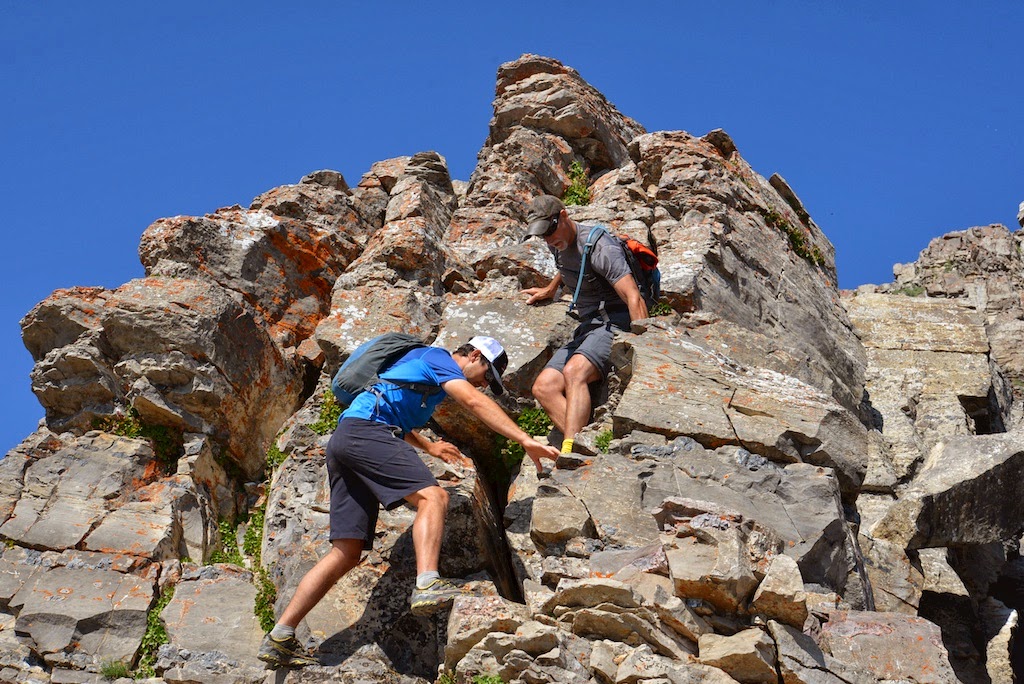
The finer points of maintaining balance and control while down climbing steep terrain


Downhill Mountain Bike
Time: 3 hours
Difficulty:  Moderate to Advanced
Gear: Approach shoes, shorts, t-shirt or base layer shirt, eye protection, small pack (light snack, hydration bladder) Your mountain bike, helmet and body armor will be provided.


Kitted up and ready to go big, and fast

"The feeling you get when putting on helmets and armor, adjusting your equipment to fit perfectly and preparing yourself mentally for the "red zone" is familiar to all warriors, regardless of the type of battle one may be preparing for." Brad


 Warrior mindset not included, but highly encouraged


For 3 hours we blasted steep trails, high speed turns and landed big jumps.  Downhill Mountain Bikes are meant to be ridden all out.  We completed 10 runs on the course before heading back to refuel, change clothes and prep for the next mission.
 
 
"Pushing your limits in new environments is a great way to reset your adaptability and improve leadership skills.  AOG's missions call for a higher levels of skill and performance and always go Beyond Normal Limits" Brad


Warrior Fitness session at Mountain Athlete
Time: 60 Minutes
Difficulty: Strenuous, advanced functional fitness workout
Gear: PT shorts, Shirt (that you don't care about), running shoes, 1 liter water
 
 
Mountain Athlete, and owner Rob Shaul are dedicated to training the most elite athletes in the world.  Some of Jackson's best free skiers, climbers, professional guides and endurance competitors train with Mountain Athlete.  Their programs are so popular with extreme athletes that naturally the Special Operations and other military units are drawn to the elite human performance programming. 


After arriving at the gym, we were met by Coach Jordan, one of the full time Mountain Athlete trainers.  He led us through a quick orientation to the gym layout, and briefed us on the custom WOD he had prepared for us.  Pain soon followed.  There were few pictures taken of the suffering.  Any hope that Coach Jordan was planning to take it easy on us quickly diminished.  After the morning Cody Peak run, downhill mountain bike session, and a 60 minute WOD, we were ready for some serious grub and sleep back at Teton Village.
 
 
 Mark recovering
 
 
As our team worked through 60 minutes of the most elite fitness programming available anywhere, it was clear to the team that we still have a lot to learn about training.  I can't wait for the next chance to work out there!
 
The gym, and the athletes that train there inspire elite performance.  Want to learn more about our workout or become a mountain athlete client?  Check out their website at: www.mountainathlete.com or join us for the next AOG Teton Mission to find out!
 
Day 1 missions complete: Cody Peak run, Downhill mountain bike course and Mountain Athlete session. 
 
Day 2
 
Day 2: Mountain Ops- Rock climbing and Team Alpine Movement
Time: 4 hours
Difficulty: Moderate- hiking, bouldering, technical climbing (up to 5.7)
Gear: Lightweight hiking pants, synthetic t-shirt, approach shoes, day pack (lunch, 1 liter water, sunscreen, sunglasses, lightweight base layer top/bottom, rain shell
 * All rock climbing equipment provided


Learn route finding and mountain navigation
 
 
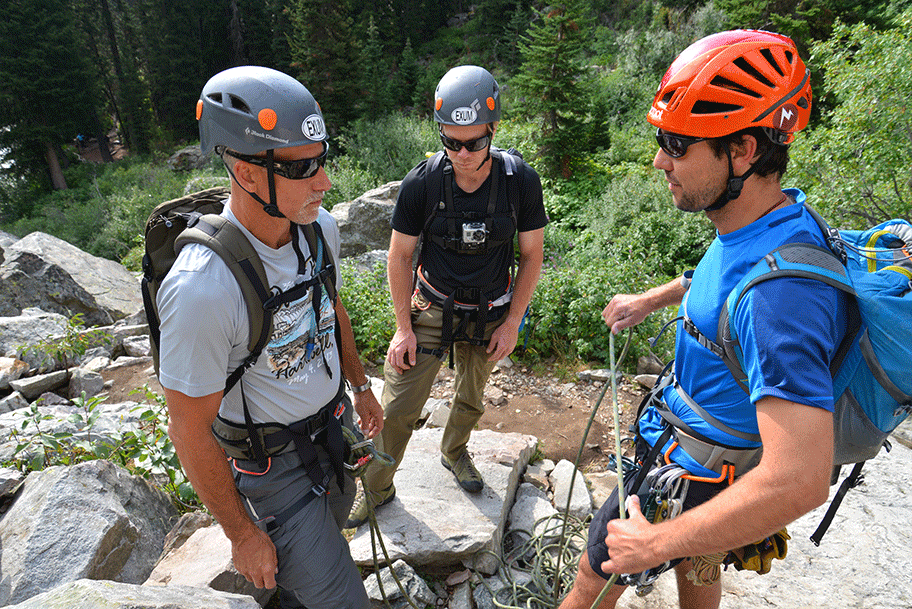
The pace for day two continued to move rapidly. Our team progressed quickly through bouldering, balance on rock, basic climbing holds and movements, rope management, belaying, route finding and alpine team movement.  One of our team, Mark, was a first time rock climber.
 
Mark gets a class on rope management and belaying
 
Fist time climbers will advance quickly and safely through the basics in the perfect classroom


"The terrain in the hidden falls area was perfect for rapid skill progression and before we knew it we were three pitches in.  The team was doing great, but I was most impressed with Mark, who before today had never rock climbed.  He was motivated, had a great attitude and grasped the techniques quickly.  Brenton had Mark belay me up an easy section and I can already sense that Mark truly feels he is learning new critical skills and is an active participant of our mountain team." Brad


Small teams rely on every member for survival
 
 
We complete the last pitch and scramble to a large table top rock where we break for lunch.  After a few team pics, Brenton reviews everything we've covered this morning. 


Day two continued: Tactical Marksmanship refresher
Time:  2 hours
Difficulty: Moderate (M4 Rifle and 9mm Glock pistol instruction)
Gear:  Long Pants, shirt, hiking boots, eye protection, M4, Glock 9MM (or similar), Small Go bag (snack, 1 liter water)
 
We spent the afternoon at a nearby range.  After a quick intro and safety brief, we headed to the pistol range for some work on the basics. 


Reviewing the fundamentals 
 
 
Slow aimed fire, both eyes open 
 
Whether leading pitches, backcountry ski routes or working the M4, Brenton has focus.
 
Brad works with Mark on mastering the M4 
 
 
Another well deserved winner at one of the many great restaurants in Teton Village after a long day of climbing and shooting


Jackson, WY (Info)
Jackson Hole Mountain Resort 6311 Ft Elevation.  Base Camp for the 2013 AOG Teton Mission.  Located 12 miles NW of Jackson, WY.  In the winter the resort boasts some of the most advanced in bounds and back country skiing in the world.  In the summer, the resort serves as a perfect launching point for multi-sport adventures including: hiking, mountain biking, rock climbing, alpine mountaineering, paragliding, horseback riding, whitewater rafting, wilderness and backcountry travel and family adventures.

Grand Teton National Park Home to the spectacular and awe inspiring Teton Range.  The Grand Teton, the highest peak in the range, rises to 13,770 feet.  The Tetons are home to some of the most challenging and technical alpine climbing in North America and attract thousands of climbers and back country adventurers each year.

Exum Mountain Guides  North America's oldest and most prestigious school of mountaineering.  Exum has been guiding clients on the Grand Teton for over 80 years.  Exum's elite guides offer unmatched instruction, inspire initiative and responsibility and lead their clients through one of a kind mountaineering and climbing adventures as active participants.

Adventure Operations Group A veteran owned company dedicated to the pursuits of modern adventurers and the human performance lifestyle. AOG offers guided adventures, leadership training and instructional programs.  Through preparation, elite training and "SOF Focus", AOG leads individuals through transformative missions designed to push the limits of personal performance, mindset, teamwork, gear and adventure travel.  AOG shares epic experiences along with our clients as we continue to go BEYOND NORMAL LIMITS.  Get more out of your self and your team with AOG.


Wednesday, October 30, 2013

"It is not the critic who counts; not the man who points out how the strong man stumbles, or where the doer of deeds could have done them better. The credit belongs to the man who is actually in the arena, whose face is marred by dust and sweat and blood; who strives valiantly; who errs, who comes short again and again, because there is no effort without error and shortcoming; but who does actually strive to do the deeds; who knows great enthusiasms, the great devotions; who spends himself in a worthy cause; who at the best knows in the end the triumph of high achievement, and who at the worst, if he fails, at least fails while daring greatly, so that his place shall never be with those cold and timid souls who neither know victory nor defeat. "   Theodore Roosevelt


Long before I started AOG, I read this quote hanging on the wall in a small office, in a non-descript building on Hunter Army Airfield near Savannah, GA.  It was in a simple frame and stamped with a unit crest that signified that it had been presented by those who truly understood what it meant to be in the arena. It stopped me in my tracks the first time I read it.  The context at the time was that I was in my first arena, learning the great enthusiasms, about victory and how to dare greatly.  I wasn't alone. I was surrounded by others also in the arena, like minded volunteers for the extreme.  Brothers who helped define it and share it.  They were, as we were reminded daily, "Modern Day Spartans". 

We knew that we were doing the unspoken deeds that most would never know or care about, and that quiet knowledge was the glue that bonded us.  The coolest thing was the recognition that we were all dedicated to the cause, the mission and pushing the limits.  There was no chance of finding a cold or timid soul in that company.  We were, united, of our own accord.

Years later, I find myself in another, different arena. Full of stress, chaos and disunity of thought and action.  When I look around, I sometimes barely recognize my environment or the people in it.  There are those who know neither victory nor defeat, nor ever will.  Those who work in ways that are unfamiliar, ways that are learned from years of modest enthusiasm, selfish devotions or just simply untrue causes.  Those who seek to divide, maintain the status quo and advance themselves by a willingness to endure a soul crushing existence of middle of the road word and deed.  They promulgate a negative bandwidth of communication and endeavors aimed at anything but actual success, victory or the team life.

It is in these times when I must retreat from this arena.  To seek the solace in the familiar feel of the wilderness, of a ruck, wet feet and a time hack.  To move fast, light and far.  To rage against the normal limits that exist somewhere between victory and defeat.  To feel pain, discomfort and to remember the truth that it makes me stronger.  To seek the undiscovered parts of my soul in this world as I find new ways to test myself, lead others and exceed the standard.  To find familiar bonds of brotherhood, new missions and to keep faith with the accord of warriors that are entering their first arena.

These are the times that you must focus on keeping the fire of your soul stoked. Question the status quo.  Liberate yourself from the oppression of predefined boundaries.  Go beyond normal limits.

Are you in the arena?

B-rad
ADVENTURE OPERATIONS GROUP

Saturday, June 29, 2013

Saturday After Action

For me, Saturday is often a great time to conduct a personal after action review from the previous week.  Like many in the US, my weeks most often resemble combat operations, and I am routinely engaged in pushing aggressively forward on multiple fronts and responsible for managing disparate priorities from competing groups of stakeholders on large scale projects. 

It is near impossible to move forward in any organization, effectively and aggressively without sustaining setbacks and failures on a regular basis.  Most often our failures are not large single events, but rather a collection of smaller cumulative micro failures that can chip away at our motivation and effectiveness with such a low signature that it's almost hard to recognize.

Saturday mornings are usually a good time to grab a cup of coffee and reflect on the collection of victories and failures I racked up during M-F combat.  I always think back to the many AAR's and post op debriefs I've sat thru.  Most people would be surprised to sit thru an actual AAR conducted by an elite unit or team.  Even on major operations involving complex planning and coordination, most de-brief points highlighting failures usually fall into one of the following categories:
  • perception
  • discipline
  • communication
  • technical difficulty
Perception- It's hard to remember a mission that either myself or anyone I know has ever been on where the actual conditions on the ground did not differ in some way from what was expected during planning.  Great teams and individuals train hard and are expected to adapt.  If you are in a Corporate Combat Unit, keep in mind that perception is one of the most difficult things to manage or understand among people who are normally not cohesive and trained to a common standard.

Discipline-  This one is easy.  At some point on every mission, one of us could have done something better.  Sometimes we get lucky and no one saw our minor mistake, and we dodged Mr. Murphy, but this is one I see often among many civilian organizations.  High degrees of discipline do occur, but are often by chance or due to a few rock stars who hold the line.  Corporations can and should train staff to be disciplined and aligned around solid core principles and time tested processes.

Communication- Think about all of the communication engagements that you will be a part of M-F in any organization.  The total number is staggering.  When they don't go well, they take a toll on both parties.  Often times two people on a team or in a corporate setting will quietly harbor small doses of anger and resentment for hours or days after an unpleasant communication engagement with a co worker or boss.  Failures of communication are the main reason for many of the real set backs and near misses in modern combat operations and among Special Operations.  Communication skills have to be constantly trained on and refined, de-briefed to the smallest detail.  You have to communicate well, period.

Technical difficulties-  "Comms went down", is probably one of the most recycled phrases in military de-briefs.  It's just a fact of life, and probably won't change until SOCOM, or TRADOC buys APPLE or Samsung and puts them in charge.  Fortunately most of us in Corporate Combat units get thru our work days without experiencing technical difficulties that completely derail our operations.  But when they do occur, realize that you must fall back on solid, basic and simple techniques to communicate and keep your team moving forward. 

These are just a few easy points to consider for your Saturday morning de-brief.  To learn more check out:  ADVENTURE OPERATIONS GROUP

Also, to hear David Rutherford talk about how to turn failure into success, check out this weekends Froglogic Radio Show at:  Froglogic Failure to Success

Have a great Saturday!
B-Rad and the AOG team.
Out.

Thursday, May 2, 2013

Bug Out Basics- Part 2

Part two in a series on Bug Out/Bail Out tactics from AOG teammate Josh:


Long gun and movement considerations

There seems to be quite a bit of discussion about “bugging out” and what kit to carry.  There are plenty of options out there but one question that continues to come up is how to stay “the grey man” and still carry a long gun.  I think we need to take a hard look at our situation, the circumstances we might find ourselves in, and what to do about that long gun.  Because we need to have some context to our situation we’ll try to paint in broad strokes, and add specifics as necessary.  To be honest, if we keep things realistic I think we’ll find most decisions won’t be too different no matter the circumstances.

By definition “bugging out” means we are moving.  We want to move from point A to point B.  What are our points???  Our home??  Work?  A vehicle?  A public forum?  A predetermined “safe” house or sight??  A hasty hide or building to occupy??  By definition we are trying to get somewhere of lesser advantage to a place of better advantage.  The exception would be moving to SOMEONE, like our family or friends in need, someone in trouble or disabled, etc.

Regardless of why we are leaving we have determined that we need to be somewhere else.  Inherently that means we have a purpose and to move accordingly.  I can’t think of a single reason to move and not have a destination and not be highly motivated to get there.  Even if you don’t have a specific location and only know the place you’re at is sucking, you still probably aren’t going to move like it’s a Sunday drive.  Speed becomes a factor.

For this discussion we’re going to talk about moving on foot.  If we have a vehicle then the point is almost moot.  Believe me, if I’m "alamo’ing" up or moving in a vehicle then the gear I chose and the time and distance I can cover are a different discussion.

So if we’re moving on foot we need to be VERY conscious of what we carry.  There are tons of discussions about what and how people will carry life saving equipment and comfort items.  We can talk about that too, but the one item that continues to arise is that pesky long gun.  Do we need it??  Should we take it??  How?  What if we don’t take it??  What are we going to do with it??

Answering some of these questions and coming up with some solutions might help us in the rest of our load out.  Determining what we carry and how we carry it also determines what we can accomplish.  Things like where we can go and how far we can travel are directly related to the solutions above. 

Simple math tells us we can go farther without a long gun.  If I forgo a long gun (in this case an M4 carbine) that means I don’t have a 7-10 pound rifle and 3-10 pounds of ammo (one mag weighs approximately 1 pound).  Can you move farther with 10-20 pounds less??  I think I can.

What do we consider in making that determination?  Now things get somewhat tricky.  Each person envisions different situations.  I think the biggest consideration is the geographic location we find ourselves in as well as the circumstances that have made us move.  Let’s run down a few somewhat generic situations and make some decisions from there.

PART 2

Back to the topic.  When do we need a long gun??  Do we need one if our vehicle broke down on a rural road and we’re trying to walk to help?  Probably not, but are we comfortable leaving it in the vehicle?  That also depends.  It depends on if you have it in something like a Truck Safe, and what the overall situation is like.  If we know it’s only about 10 miles back to somewhere we can get some help then it might be better to leave the rifle and haul ass to a known destination.  It’s about probabilities and in this situation, stateside, it’s probably best to leave the long gun.  Even with a longer distance (for you truly rural folks) I don't think it changes much.

 If the exact same situation happened in Iraq or Afghanistan, you can bet the long gun is coming with.  Talking to some coworkers last night we went over every situation we knew of where people had to un-ass a vehicle and most said that at the time they were worried about just getting out and grabbing ANYTHING was second on the priority list.  Several made mention of grabbing their bags but burning everything else (including belt feds) in place.  I’m not saying if any of these actions are right or wrong only that the situation dictates what we’re going to do.  

 Another situation might be some kind of natural disaster.  For this situation let’s assume we’re ahead of the power curve and a disaster is pending, but hasn’t occurred yet.  Some examples might be hurricanes, tornadoes, fires, etc.  Often times the routes from a city to a more rural area become clogged.  We might just need to make it from our home or business to another “better” location.  In this situation we will probably encounter many more people, both good and bad. 

Again, is the long gun necessary?  Maybe not yet, but I probably wouldn’t want to leave all my guns to be burned in a fire.  I’d like to think that even if I don’t need the rifle right now, it might be the only chance I have to keep possession of one.

 The next logical “threat” would be the same situations above, but, for whatever reason, we’re in the thick of it or post disaster.  Think hurricane Katrina or some of the looting I’ve seen in the Midwest post tornado.  In this situation we can expect more social unrest, historically meaning people become more desperate and predatory.  Do we need a long gun??  If I’m moving through an area full of people capable of horrible acts for their own self preservation I’m probably even more inclined to move as quickly as possible.  I don’t think provoking any actions from people in this type of situation is advisable.  What I mean by provoking is giving them any reason (in their eyes) to interact with you.  Moving as quickly and quietly as possible seems to, again, be the best answer.

 I’m going to stop there because any situations we come up with past this are probably not based on history and might seem a bit “far off” for some.  I think the examples we’ve chosen are somewhat realistic and if we discuss these events we probably can get some decent ideas for “end of the world, social breakdown, zombies, et al."

 So what are our choices??  Leave the long gun, hide the long gun, take the long gun but have it concealed, take the long gun and look like you’re ready for a fight?  Anything else?
 
More on those choices in Part 3, coming next week.
Until then, stay full tilt and focused!

Sunday, April 28, 2013

Bug Out Basics

From AOG Teammate Josh-
 
The concept of “bugging out” is not new, although there are some new twists.  The premise is whatever situation we are in, we need to be somewhere else that is better.  The reasons are many; natural disaster, disabled vehicle, terrorist attack, etc.  One constant is having a small bag that will assist you in getting from point A to point B.  The bag, sometimes called a “go bag” or “bugout bag”, should be easily accessed, easy to transport, and contain whatever items needed to augment your personal gear and be appropriate for whatever location you’re in.

A few things to consider when choosing a bag for this purpose are its overall size, how it’s going to be carried, and the general appearance of the bag.  I’ll expand on each point.  If a bag is too big it will inevitably get overloaded with things you probably want but don’t necessarily need.  This becomes contrary to being easy to access and easy to transport.  If it’s too small then obviously it might not be able to carry essential items.  Backpacks make a perfectly good platform for a go bag but it becomes very difficult to access items in the bag quickly.  A shoulder bag, fanny pack, or lumbar pack makes access much easier.  The tradeoff is more weight can be carried easier in a backpack.  The overall appearance of the bag should be complimentary to you as well as the environment you are in.  A soldier working in Baghdad will probably need a bag that appears different than a bag for a soccer mom in St. Louis.  The point is it might be best if the bag doesn’t draw undue attention while moving within your environment.

I’m not going to delve into the exact contents of the bag but where you are will generally determine what you need.  If you are in the desert the procurement and carriage of water might be high on the list.  If you find yourself in a non permissive environment maybe a few extra mags, night vision, and a satellite phone might be needed.  I would concentrate on communications, signaling, self defense, and basic needs like staying warm and hydrated.  Most importantly we are trying to get from point A to point B.  I would suggest items that help accomplish that specific goal.

Tuesday, August 14, 2012

2-day Cathedral Traverse, Grand Teton National Park- Part 1 "Don't Stop, Don't Fall"

"At least once a year, do something bold, that requires real effort, real risks and where the outcome is uncertain"- B-Rad

Mission: Try to hang with Brenton Reagan of Exum Mountain Guides for 2 days in the Grand Tetons.

He had thrown down the challenge to me 2 years ago at the Outdoor Retail Show in Salt Lake City. "Come out to Jackson Hole, let me show you what we do for a few days".  He had repeated the challenge this year.  I knew that Exum was one of the most respected Guide services in North America.  I knew that the Tetons contained difficult routes.  This was exactly the kind of thing I love dropping into.  I had to go.  So this year, I took him up on the offer. We would attempt a 2-day, alpine style assault on the Grand Traverse, a route that contained some of North Americas most challenging and technical alpine terrain.

I had carved out some time in early August for the trip.  It would be difficult for sure as I had a compressed schedule, with 1 day to acclimatize and 2 days to complete the route.  There would be no warm up or practice climbs, we would jump straight into it.

I arrived in Jackson Hole on Saturday August 4, 2012 in the late afternoon.  The drive from Jackson Hole Airport to Teton Village, revealed a bustling heavy summer crowd that ranged from climbers, hikers, mountain bikers and kayakers, to large groups of Harley riders, cowboys, families in RVs and everyone in between.  Jackson Hole,WY is a mecca for just about any type of outdoor recreation you can think of.

I checked into my room at Teton Village late Saturday afternoon.  Teton Village is approximately 11 miles from Jackson Hole, and sits at about 6600 feet altitude.  In the winter, Teton Village is the spot for some of the best skiing the West has to offer.  In the summer, Teton Village is transformed into a world class downhill mountain biking resort but also boasts miles of accessible hiking trails, nearby whitewater rafting, horseback riding, wildlife tours, paragliding, and sits on the border of Grand Teton National Park. 

Grand Teton National Park is home to some of the most beautiful mountains found anywhere in the world, and some of the best alpine mountaineering in North America.  Exum Mountain Guides is among the oldest and most respected Mountain Guide Services in North America.  Exum's AMGA certified guides are in a league of their own when it comes to leading clients on truly inspiring and challenging adventures. Exum has been guiding clients on the "Grand" longer and with more summit success than any other company.

Check them out here- http://www.exumguides.com/

With only a day to adjust to the altitude since arriving from VA at sea level, I decided to spend Sunday drinking water and going for a short hike on a nearby trail just to get loosened up.   


I met up with Brenton at 1:45 AM Monday morning, for the drive into the park.  After a quick stop at Exum's office, we arrived at the Lupine Meadows parking lot at about 2:30 am, and began the job of finalizing our gear.  We divided up the tent and climbing gear, cinched down our packs, turned on our headlamps, and were on the move by 3:00 AM. 

The summit of Teewinot was our first goal, but to get there required gaining approximately a mile's worth of altitude.  We hiked through the darkness initially on a small well marked trail, later encountering steep switchbacks that slowly gave way to rock fields and class IV scrambling.  I was already feeling the effects of the altitude, but kept pushing and reciting my mantra for this trip, "Don't stop, don't fall".  We set a robust pace and I was glad that I had chosen the type of training I had been practicing for the past few months.  Even so, I had to ask him to slow down just a bit a few times.  Exum's guides can move fast and light in the mountains.  Eventually, as we neared the summit and the first signs of daybreak began to appear, we dropped our packs and Brenton tied me in to a short rope, and we set out for the summit.  We tagged the summit of Teewinot at about 6:30 AM, and from there the view in all directions was spectacular.  1 down, how many to go?


Dark clouds approached from the Southeast (seen behind me in the above picture), and revealed evidence of what local forecasters had predicted as a 40% chance of showers for Monday August 6, 2012.  Soon, we were taking cover next to a rock wall, wearing all of our Gore-Tex as we waited out a 30 minute rain storm.  We contemplated turning back, but saw no lightning and soon the rain ended. We decided to push on.

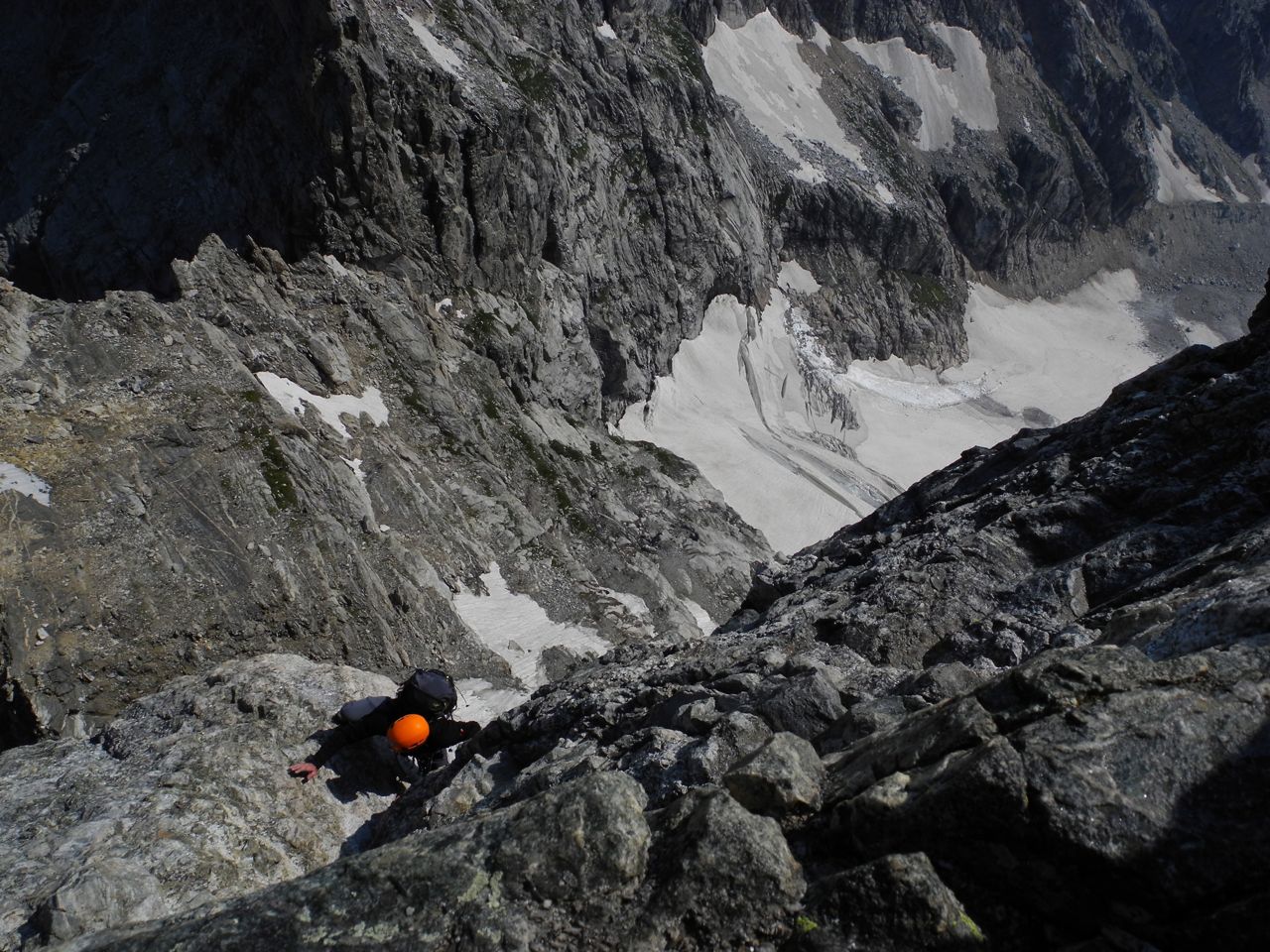
The rain made the climbing slow, and a little treacherous for the next few hours as the overcast skies slowed the drying out of the extremely exposed and challenging terrain between the summit of Teewinot and Mount Owen.  "Don't stop, don't fall".  We continued our slow push to Owen.  Down climbing, rappels, exposed ridges, ice ax and snow to the Koven col.  A fall here, would not be good.  "The Summit of Mount Owen is one of the most difficult summits in the park, by it's easiest route", Brenton said as we tagged it and started our down climb.  I was feeling the effects of little sleep and a rush to 12,928 feet, "Don't stop, don't fall". 

The rain and resulting slow climbing meant that a 2 day Grand Traverse probably wasn't going to happen, combined with my short time at altitude, our progress wasn't fast enough to go for the traverse.  I was physically and mentally crushed after 13 hours of hard climbing on day 1, still moving and climbing, but probably not fast enough to make it over the Grand before dark. We decided to bivy on the West Ledges, between Mount Owen and the North Ridge of the Grand.  It was a good call, I needed to recharge.  This mission was now a 2-day Cathedral Traverse, and we still had one full day of very challenging climbing ahead of us on the Grand.


At the bivy site on the West ledges, unreal view.  We arrived with about 8 OZ of water each, and no snow melt to refill.  Brenton rapped into the Gunsight notch, chopped snow with an ice ax, and climbed back out so we would have snow to melt for water.  Much appreciated!

A night's sleep at near 12,000 feet was exactly what I needed.  I woke up feeling stronger.  Day 2 would be heading toward the summit of the Grand, via the North Ridge and Italian Cracks.  Some GU, a little cheese and salami, and snow melt water for breakfast and we were moving again.


                                          The first of 11 pitches on the way to the summit.


AOG Individual Capabilities Enhancement (I.C.E) training with Exum!

                                                                                
    "Don't stop, don't fall"  Climbing through this section required total focus and control.  Little margin for error and no place to fall.  2-man team, over 13,000 ft high on an alpine mountaineering route means relying on your training, physical condition, equipment and each other. 


Summit shot on the Grand, 2 day Cathedral Traverse.

Climbing with Exum is unlike any other experience, because they are unlike any other guide service.  They will put you in the middle of real adventure, and you will come away with new or renewed skills, and a sense of achievement that will leave you wanting more.  Brenton, one of Exum's most experienced guides, is also involved with XMS3, Exum's Military and Special Operations Mountaineering Programs.  You will not find a more advanced or relevant training program anywhere that will prepare your unit or team for the dynamic challenges of conducting tactical operations in an alpine setting.  Check out XMS3:  XMS 3- Mountain Systems Safety Survival

This was a tough 2 days.  I arrived in Jackson Hole with one day to get ready, and found myself being truly tested from the very beginning.  Capabilities stretched, skills enhanced and new friends made!

This trip is accessible and achievable by anyone willing to put in the preparation and training.  The summit of the Grand is within your reach.  Exum specializes in 1 or 2 day summit climbs.  Contact AOG to find out how I planned for this trip, or contact Exum if you are ready for the challenge!


Wednesday, July 20, 2011

Get yourself "in the zone", read "Click. The magic of instant connections"

This is a book about those mysterious moments when we click in life. Those moments when we are fully engaged and feel a certain natural chemistry or connection with a person, place or activity. Written by brothers Ori and Rom Brafman. Ori is an organizational business consultant and Rom is a psychologist. Click is a psychological investigation of the forces behind what makes us click. What are the hidden forces working to make these magical connections occur? Click accelerators: vulnerability, proximity, resonance and similarity are explored and the authors explain how they work together to create "peak experiences". If you have ever been "in the zone" even once, at work, at play or in a relationshiop, and want to know if it's possible to increase your chances of finding your way back to the zone, check out this book. If you regularly live "in the zone", Click will help you to understand what's going on behind the scenes when it all just feels right and you are in tune and connected to the immediate world around you.

Exerpts from Click

..."similarity, no matter what form it takes, leads to greater likability."

"Nonetheless, the relationship between industrialization and depression is so strong that scientists know there is some correlation between the two. What is it about the process of a country becoming industrialized that leads to depression?"

"The experience of men facing life-or-death situations together created unbreakable bonds. In other words, it didn't matter what type of person went into combat-simply the fact that they faced combat together made the soldiers' bond stronger. It is one of the most emotionally charged experiences imaginable."

A quick and easy read, check it out.

Saturday, January 1, 2011

Tactical Adventure Course 2007


In the spring of 2007 I was told on a Friday afternoon that I would have a group of 10 corporate executives showing up on the following Monday.  They would be there for 5 days and were looking for a teambuilding experience.  My only guidance was that they didn't want to be seriously hurt, beyond that, they were up for anything. 

I quickly went to work and designed a challenging 5 day Tactical Adventure Course that consisted of 4 days training with a final mission.  This course was seriously fun for everyone.  We trained them for 4 days on a variety of Special Operations stuff, too much to mention here, using the crawl, walk, run approach.  They were challenged, learned to communicate with each other in new ways, how to think on their feet and solve problems as a team all the while doing things they never imagined.  On Thursday afternoon we gave them their mission brief.  Their planning and preparation lasted well into the night and on the following morning, their mission began. 

Most of their training and mission will remain confidential, only they know the real story, but it was a tough mission, required them to work together using all of their training, and in the end, they won.

Here's a few brief shots of the final day.

After mulitple insertions by helicopter, the team linked up and conducted movement to the objective, where a surprise was waiting for them.


With little time to spare, they had to work fast to sort through some unexpeced challenges and get moving before they were comprimised.


Don't spend too much time talking about it, action is required.


Two team members making a fast escape off the X.


I don't know if they had more fun, or I did, but it was a great 5 days.  Everyone learned more than they expected and the daily debriefs gave all participants a chance to express individual perspectives and thoughts.  Job well done guys! 

Let Adventure Operations Group design a custom Tactical Adventure Course for your team or small group.

http://www.adventureoperationsgroup.com/
info@adventureoperationsgroup.com